

Across the digital economy, AI is forcing a reckoning. Architecture, not simply algorithms, is what will define AI’s impact on digital advertising. Systems that once thrived on friction, opacity, or short-term hacks are being revealed in real time. The quality and depth of an enterprise’s data is quickly becoming exposed. Opex investment is being replaced with capex investment – a clear signal that companies are realizing intelligence can’t compound on rented infrastructure. The companies that thrive will be the ones built on sound design and architecture that learns, adapts, and improves the more it’s used. AI rewards those who build, not bolt on.
In advertising technology, this shift is especially urgent. For years, ad tech players scaled faster than they evolved. Data was pushed to move faster than insight, automation outpaced understanding, and efficiency was too often sacrificed for complexity in search of shiny new objects to sell to advertisers. But as AI pushes every decision into sharper focus, our industry has reached a point where we require a new foundation.
AI can only transform digital advertising when the architecture beneath it is built for intelligence, speed, and scale.
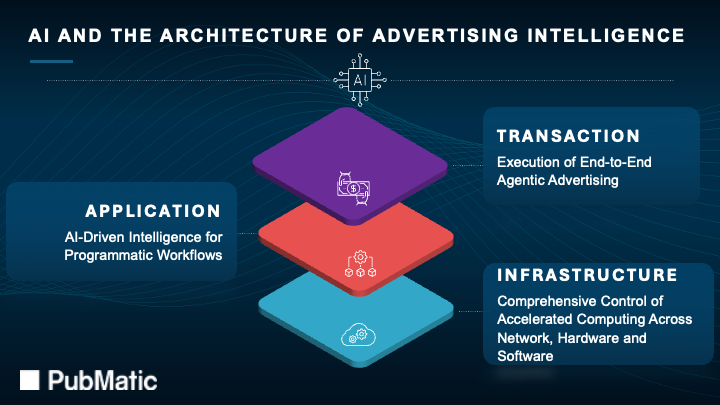
That foundation is what I call the Architecture of Advertising Intelligence, a three-layer framework that connects infrastructure, application, and transaction. It is the model for how AI turns from concept into capability, from demos into durable systems, and from experiments into business outcomes.
Layer One: Infrastructure — Where Intelligence Takes Shape
Every revolution in technology starts below the surface — in the data centers that quietly power transformation. In AI, that foundation is the graphical processing units (GPUs) that drive compute, the storage and memory that move terabytes of data instantly, and the fiber that interconnects the world.
In programmatic advertising, the quality and configuration of the infrastructure directly determines the quality of the intelligence. Real-world signals already show this. For example:
- Next-generation GPU inferencing is enabling up to 5x faster bid responses, which in turn reduces auction timeouts by more than 85%, recovering millions of dollars in previously lost advertising opportunities.
- GPU-acceleration of data pipelines shifts systems from batch to stream processing, dramatically improving the quality and relevance of decisions at lower latency.
- High-bandwidth GPU clusters process more signals per impression, allowing more sophisticated traffic-shaping decisions which ultimately create the opportunity for an advertiser to reach a consumer with the right message at the optimal price point.
Infrastructure is where intelligence becomes embedded, not outsourced. It’s the layer that turns scale into learning, and where the compounding engine separates companies built for AI from those merely band-aiding it on.
Layer Two: Application — Where Intelligence Learns to Work
The application layer is where AI moves from potential to performance. When intelligence is woven directly into workflows, from campaign planning, forecasting, and setup to pacing, troubleshooting, and optimization, it transforms how digital advertising operates.
At this layer, AI is not replacing human judgment. It’s amplifying it, freeing up the capacity for real outside-the-box campaign planning. By eliminating latency and surfacing insights in real time, people can focus on strategy, creativity, and value creation rather than maintenance and triage.
We’re already seeing this shift in measurable ways. AI-driven workflow automation is reducing campaign setup times by 87%, cutting troubleshooting by 70%, and enabling continuous optimization that would be impossible for human teams alone. These gains don’t just make individual tasks faster; they fundamentally reshape what teams are capable of.
Every application that learns improves the system around it. That’s the defining trait of real intelligence: it compounds and regenerates.
Layer Three: Transaction — Where Intelligence Meets the Market
The final layer is the frontier where agentic AI begins to transact, negotiate, and optimize autonomously. This is where intelligent systems begin to interact directly, optimizing, verifying, and negotiating outcomes autonomously.
At this layer, AI can take on the entire operational backbone of campaign execution – building, managing, pacing, and optimizing campaigns continuously, while humans focus on strategy, creativity, and true value creation.
Industry-wide momentum is already underway. Emerging agent-to-agent protocols such as the Model Context Protocol (MCP) and the Ad Context Protocol (AdCP) are creating the interoperability, metadata exchange, and trust frameworks required for autonomous systems to transact safely and efficiently.
When every transaction contributes new data back into the system, the market itself becomes self-improving, a true living network of advertising intelligence.
From Artificial to Actual Intelligence
The industry’s fascination with AI prototypes and demos is valuable. It keeps imagination and healthy competition alive. But imagination doesn’t scale alone; it needs the right scaffolding.
The companies that will define the next decade of ad tech aren’t those chasing the latest breakthrough, but those engineering systems that make breakthroughs reliable and repeatable.
That’s the promise (and the challenge) of the Architecture of Advertising Intelligence. It’s a framework that moves AI from hype to habit, from potential to proof. We are quickly moving toward a machine-to-machine advertising economy, where strategy is human, but execution is intelligent, autonomous, and instantaneous.
The future of AI in advertising won’t only be decided by who builds first, but by who builds to last.